If you were to close your eyes and picture Switzerland…you’d envision glorious Gimmelwald! The quintessential Switzerland village. I almost don’t want to share its magnificence, because it is pristine as it is – without too many visitors. The only way to get there is via cable car (gondola) or hiking. It is truly one of my top locations on this Earth.
Getting to Gimmelwald:
Fly to Zürich Flughafen
SBB Train from the Zürich airport to Interlaken Ost (~3 hours). Disembark and find train to Lauterbrunnen.
Train to Lauterbrunnen*. *This train has two parts – get on the first 1/2 that goes to Lauterbrunnen. The cars will be marked. (~20 minutes). Disembark the train and cross the tracks, and walk to the right to the bus stop.
Bus Lauterbrunnen to Stechelberg Schilthornbahn. (~12 minutes). Arrive at the Stechelberg gondola station.
Gondola Stechelberg – Schilthornto. Get off at the first stop and behold: Gimmelwald!
There’s only one way around the village of Gimmelwald and that’s with your own feet. You will feel like you’ve just stepped back in time and perhaps inside the movie, “Heidi” as you inhale all the beauty and wonder of the Alps surrounding you. Large open fields of green with cows and cowbells and working farms encircled by a stunning mountain range. It is truly spectacular. Time slows down as you walk to your chosen hotel or hostel accommodation.
Accommodations in Gimmelwald:
I stayed at the charming Swiss chalet, Hotel Pension, (book on: Hotels.com) which has a sweet restaurant (indoors and outdoors) and a Biergarten with amazing views right on the edge of the Alps. Note that not all the rooms have a private bathroom, so if this is important to you then read the descriptions carefully. There are a few other options for accommodations in the village, and they are all very similar.
Food in Gimmelwald/Mürren:
Wait until you hear this! You can walk down the paved path and go into a farmer’s residence, open the little refrigerator, take out fresh cheese, fresh milk, yogurt, eggs, sausage and bread and leave your money on the counter. For real! Other options, including hiking up the mountain path to the market in Mürren (a larger but also car-free village) and/or eating at the restaurant at the hotel (Hotel Pension) or in Mürren.
Paragliding in Gimmelwald:
This was an absolutely amazing experience. So calm and peaceful as you glide through the air with your professional pilot and take in the all the beautiful sights from above. (I expected raging winds to be passing by me and to be terrified, but it was quite the opposite. I’d do it again in a second.) I used Airtime Paragliding. They met us locally, explained the procedure, and we just ran a few steps and away we soared through the valley. An unforgettable, beautiful experience and highly recommended.
Hiking Map
Hiking in Gimmelwald:
So many options for hiking through the Alps through fields of wildflowers, little Swiss huts, streams, waterfalls cascading down the mountains and wondrous views. Be prepared with plenty of water, grab a hiking map from your hotel, and off you go! I used the hiking map above from the Mountain Hostel which is right next door.
Hike 9 in Gimmelwald (see map above):
I highly recommend the 10.5 mile loop which is hike 9 (Gimmelwald – Obersteinberg) on the map, as the trek goes through many types of terrain including fields, forests, along the top of the mountain, and along the edge of the mountain with views that literally made me tear up with awe.
You’ll be treated to amazing views of the summits rimming the head of the Lauterbrunnen Valley. Also in the middle of the hike is the remote Hotel Obersteinberg which is a lovely place to have a snack or a drink. Do be careful leaving the hotel to get back on the trail as there’s an electric fence, and if your hiking pole should hit it…it might scare the heck out of you. Don’t ask me how I know!
Hike 3 in Gimmelwald:
Other lovely hikes include a 1/2 day hike to a waterfall: hike 3 Gimmelwald – Sprutz – Spielbodenalp – Bryndli. Also the hike down to Stechelberg and back up is another 1/2 day option.
Walk to Mürren:
A nice 40 minute walk up the mountain through the Lauterbrunnen Valley, on a paved path, is the larger, but also car-less village of Mürren perched on the edge of the Alps. You’ll find quaint shops, restaurants, entertainment and more alpine scenery to behold. Mürren has a market for food/lunch to take along on your hikes including prepared foods, cheeses, Alpine meats, and bottles of local wines.
Other options to get to the tops of mountain peaks without hiking include: Jungfraujoch or Schilthorn. There are some opportunities to get to these peaks and hike down as well.
Bern, Switzerland:
On the way back to Zürich, stop in the picturesque city of Bern (where there is a transfer of trains to get back to Zürich). You can lock your luggage up at the train station while you visit the city. The city is quiet and calm and easily explored on foot.
Bern is known as the city of fountains. You can fill your water bottle up with fresh spring water from the fountains all over town, some of which are over 500 years old. In the River Aare you can actually get in and swim or float down the river. Strangely, there is a bear pit located right in the city!
Copper Mountain is the best place to enjoy the Colorado outdoors, in all seasons, in my humble opinion. It’s a quaint ski village located right in the heart of the Rocky Mountains. There are loads of outdoor activities, along with cute shops, outdoor/indoor restaurants that overlook the mountain, and plenty of entertainment – all within walking distance of each other as well as close to many of the accommodations. Not too big and not too small and a down to earth kind of place.
There are 3 villages, all at the base of the slopes/mountain and interconnected with a free, easy shuttle service. The Copper Village is also easily walkable from condos to restaurants, markets and shops! The Copper Mountain Village design is excellent – everything is “right there.” If a get away is in order there is an easy 10 minute shuttle service right to the adorable town of Frisco for more dining/entertainment options.
I also like that Copper is easily accessible – just 1.5 hours to the west of the Denver International Airport (DEN). It’s a straight shot along Interstate 70 which is maintained throughout the year. Other close airports are Eagle County Regional Airport in Vail (<1 hour away) or Colorado Springs (<3 hours away). Alternatively, there is a shuttle service between the Denver Airport or Eagle County Airport and Copper (Epic Mountain Express or Summit Express).
Center Village of CopperCopper Village
Lodging at Copper Mountain
Hotels.com, Booking.com, Cheaptickets.com, VRBO.com and coppervacations.com have reasonably priced rentals (including condos) right in the Copper Villages. Most are ski-in/ski-out or easily walkable to the slopes or mountain. I recommend staying in center village as the shops and restaurants are right there (as well as the American Eagle and American Flyer lifts). East and West Village are also quite nice! Book ahead especially for winter.
WINTER AND SPRING/FALL ACTIVITIES at Copper Mountain
Downhill Skiing/Snowboarding:
Copper has with a wide variety of terrain and many options for first timers to seasoned professionals skier/snowboarders. Plus, due to the high altitude, the slopes are skiable for longer than many other resorts – from November to mid-April. The resort is well thought-out and organized, so it’s easy to mix and match green, blue and black runs once getting up a lift or to stay the course. My fave run: Take American Flyer lift then get off to the east and head down to Rendezvous lift. Take the lift up and ski Coppertone all the way to the bottom – it’s just breathtaking! A fun little jaunt at lunchtime is the T-Rex Grill on the west side of the mountain.
Note that Copper has many slopes (140!) for every kind of skier/snowboarder out there and is seldom crowded. Plus there are bowls and parks and pipes and all kinds of challenging areas. If you are into hopping from one resort to another then you can easily get to Breckenridge, Arapahoe Basin, Keystone and Vail – all 25 minutes or less away. But I prefer to stay at Copper – it’s the whole package right there.
Kids and first time skiers/snowboarders:
Another huge benefit to Copper is the option to take kids to the Green Acres area where they can learn to ski with you (family or friend taught) for a mere $20 lift ticket on Pitchfork. If they are young enough then they will think they are getting the whole experience with downhill skiing and a real lift. I did this for years. 🙂
Cross Country/Nordic Skiing Near Copper Mountain (Frisco)
To cross country ski is only a quick 15 minute drive over to the Frisco Nordic Center. The staff could not be more friendly and helpful in getting first timers or seasoned skiers out on their trails. They have cross country skis to rent and snowshoes as well. There are over 17 miles of groomed trails for all levels and a map is provided; although, it’s not easy to get lost. I am a “classic” cross country skier which means I utilize the grooved groomed trails. The other type of technique is skate skiing which is a bit more free style with similar movements to ice skating. Both types of trails are available here.
YaktraxSnowshoes
Snowshoeing and Hiking in the Spring and Fall at Copper Mountain
So many options for snowshoeing/winter hiking near Copper! Depending on the amount of snow – you may need a pair of snowshoes to stay on top of the snow, if it’s deep and sinking into the snow is possible/probable. However, if it hasn’t snowed heavily in a while and more stability is needed while walking on the snow/ice then use Yaktrax . Put the Yaktrax on the bottom of boots for better traction on snow packed trails to prevent slipping. They’re reasonably priced for $25-$30 and are packable. Photos above.
Snowshoe rentals are available at Copper Mountain (in the West Village only – at Copper Sports West)*, Frisco Nordic Center and at Columbine Ski & Sport in Dillon. They are affordable – about $25/day which includes poles.
I absolutely love snowshoeing especially through trails with large, snow-capped trees and being able to traverse over virgin snow in the stillness and quiet of the mountain. It’s so peaceful and calming and free. So, I bought my own snowshoes ($90-150) that came with a backpack and even fits in my checked baggage or can be checked separately, for a flight, in the backpack. Check out Costco’s online prices.
Snowshoeing and Hiking Trails Near Copper Mountain:
Turk’s Trail and B&B Loop
Turk’s Trail is one of my favorite winter hikes of all time. Every new turn was absolutely magnificent and literally breathtaking. The snow on the majestic trees sparkled through the filtered sunlight in this serenely quiet land. There were just the right amount of other hikers for me – maybe 8 cars in the trailhead lot and tons of trails to choose from for a lovely hike.
Note that this winter hike is closer to Breckenridge than Copper but very worth the short drive. It’s recommended to have an AWD vehicle to get to the last 1/2 mile to the trailhead on French Gulch Road. The trailhead is right near the Country Boy Mine. Once on the trail go toward the left. At the major split (there are a few spurs – don’t take them – stay on the main trail) stay to the right onto Turk’s Trail. At 1.5 miles on Turk’s Trail it connects with the B&B trail. Go left here to complete the oval back to the trailhead. Total of 2.9 miles. Map above is from All Trails.
Mayflower Gulch Trail
Mayflower Gulch Trail is a very pretty 3 mile (round-trip) trail up to a destination. (There are lots of people that like to have a reason to hike – I’m not one of them, but if you are then this trail is for you.) The hike leads to very cool abandoned miners’ cabins, a virtual ghost town. Legend has it that there is still a lot of gold to be found in that area.
Powderhound Loop of Colorado Trail
The Powderhound Loop of Colorado Trail is a 2.82 round trip beautiful winter wonderland. Google map it here. It’s a fairly packed down trail, but snowshoes are recommended for going off trail and trekking through the glorious deep snow. The trail heads through a forest of tall pines with the whispering wind as the soundtrack. It was quiet and peaceful and the gradient was easy to hike up and wander. Plus there was not a soul around. Follow the blue diamonds. Highly recommended!
Miner’s Creek Trail
Miner’s Creek Trail to Rainbow Lake Trail and Peaks Trail is a lovely out and back trail that you can make as long or short as you wish. Note that the Miner’s Creek part of this trail is a road with packed snow. Once onto the Rainbow Lake or Peaks Trail – it’s more of a narrow hiker’s trail. It’s fun to traipse through the woods with snowshoes and be one with the deep snow then come back to the groomed trail for a break from time to time. However, if you only have hiking boots and/or Yaktrax then that works too as long as there hasn’t been a lot of snowfall recently. It’s a pretty hike with marked trails.
Frisco Nordic Center for Snowshoeing
Just 15 minutes from Copper Mountain is the Frisco Nordic Center which not only has cross country ski trails but also has separate snowshoe trails. There is a one mile and a three mile option. I did the three mile option with views of the nearby lake and through small to medium height pine trees. There is a trail pass needed and can be paid at the Nordic Center.
Officer’s Gulch Trail
Officer’s Gulch trail at exit 198 off of I-70 is just beautiful in the spring. While it’s just 1 mile around the lake there are offshoots of the trail that are options for longer and more challenging hikes.
Salt Lick Trail
Salt Lick trail in Silverthorne was a spring hike for me (April) so Yaktrax did the trick for most of it. This trail had a lot of open meadows and a small amount of treed trail. The first half of the trail is well-marked but can get confusing after that. Use the AllTrails app as there’s navigational service at this trail.
*Copper Mountain West Village. A note about snowshoeing right in Copper Mountain Village (West). Snowshoe options are quite limited right here. As in there are wide, plowed trails (for tracked cross country skiing and hiking – without the need for snowshoes) that are “recommended” for snowshoeing. Snowshoes aren’t needed here unless it’s after a huge snow dump. Options for going off this plowed trail are very limited as there are very steep inclines along the trail. Also, this option goes under Highway 70 in each direction which is loud and not pretty. Copper Mountain does offer guided snowshoe hikes with wonderful and friendly guides. However, the trek that I just described is where they snowshoe. Again, snowshoes are not needed most times unless a fresh, large snow has just settled in.
Snowshoes are safer and required on trails in most of the winter months, as the snow keeps on falling. Remember that you are in “elevation” as in 9k feet and above, so most activities will require more inhalations/exhalations overall.
Safety note for hiking and snowshoeing
Get the AllTrails app (free version) and follow it to make sure you are staying on the trail especially if you’re near a body of water. Some rivers do not freeze in the winter but may be partially covered with snow.
Pack more water than you think you’ll need for the hike.
Keep your phone warm so the battery doesn’t die. Put the phone in an inside pocket of your coat or in the vicinity of a hand warmer. My phone has died before because it got too cold.
Bring a backup phone charger.
Wear layers.
Bring snacks.
Always tell someone where you are going and when you expect to be finished.
Rocky Mountain Coaster: I can’t tell you how much I loved this thing! It’s like your own private roller coaster/alpine slide with beautiful scenery 360 degrees and one thrill after another! It goes up to 25mph (of course, that’s up to you, because you control it), up and down and around some major bends. Crazy fun!
Iceskating: The ice rink in the middle of Center Village (“West Lake”) is the perfect place to bring friends and family. We borrow the free brooms and play broomball! There are also skates to rent for $10 at City Pop.
Music: In winter, check out Lefty Lucy duo for fun and entertaining music at Jack’s Bar for après ski!
SUMMER ACTIVITIES at Copper Mountain
Hiking Trails mentioned above.
Kayaking, Canoeing, Paddleboarding Crisp, clear and flat Lake Dillon works perfectly for a day on the lake surrounded by mountains. It’s a quick 12 minute drive from Copper and there are opportunities, at Frisco Marina, to rent all sorts of water craft.
Biking This can be an easy bike ride or made difficult (if you do the round trip). From Copper’s Center Village take the Ten Mile Canyon Trail (paved path) from Copper to downtown Frisco. It’s a 7-mile downhill scenic bike path. Plenty of opportunity to stop and gawk at the beauty or to climb rocks. You can either bike back up to Copper (it’s all uphill, of course) or hop on a shuttle (bikes are allowed) and zip right back to Copper after having lunch in the charming town of Frisco. Rent bikes from Gravitee Boardshop right in Copper’s Center Village. The “shuttle” is the free Summit Stage Bus.
White Water Rafting Take a wild ride down the rapids on the Arkansas River. I did Brown’s Canyon 1/2 day with Noah’s Ark – the guides were very skilled, and I felt safe the entire time. Lots of thrills and super fun! It’s in Buena Vista – about an hour and 10 minutes away from Copper.
Bumper Boats and Hydrobikes Right at West Lake (in the Center Village).
Banff is an adorable ski town. One main road with lodges and restaurants all within walking distance of each other with winter adventures just around the corner. Sweet mom and pop everything stores and restaurants all super well kept with friendly shopkeepers and wait staff. Be prepared to watch and talk a lot of hockey in the winter. When you hear “Are you going to have the game on tonight?” they are talking hockey – not football. 😉
I flew into Calgary, Alberta and drove 1 1/2 hours west to the beautiful village of Banff. The highway between the 2 areas is mostly flat and very well maintained. While approaching Canmore (the cute town before Banff) the mountains are just stunningly laid out ahead of the highway. Ask for an AWD rental car if you have any reservations about driving in winter. There is also a shuttle service that runs between the two locations.
Day 1: Lake Louise Hiking and Ice Skating
Lake Louise is an absolute must – a magical experience. I have to admit that until I got to Banff – I thought that Lake Louise was right in town. Actually Lake Louise is about a 45 minute drive from downtown Banff but gorgeous the entire way with tall pine trees layered in snow and snow covered Canadian Rockies (especially Castle Mountain) which are absolutely stunning. This is also a mostly flat and easy drive with cleared roads if it isn’t currently snowing. Lake Louise is one of those turquoise blue lakes, in the warmer season, that you see in all the photos. (Other turquoise blue lakes at Banff National Park: Peyto Lake, Bow Lake, Lake Minnewanka, Moraine Lake)
To get to Lake Louise – navigate to the Fairmont Chateau Lake Louise (a world-famous luxury resort hotel built in 1890) which is the impressive landmark hotel of the area that sits alongside the beautiful, frozen Lake Louise. Parking is free in the winter.
Hiking:
We hiked the flat yet picturesque trail #4 next to the frozen lake which is surrounded by thousands of ginormous snow covered pine trees outlining the lake in splendor. A beautiful and magical sight to behold! Hike out (on trail 4) to the massive frozen waterfall. There was a woman ice climbing her way to the top while we were there. Terrifying even to watch, actually. The trail continues into the forest past that point or turn around and walk back on the frozen lake.
Ice Skating:
The Fairmont rents good quality ice skates near the lobby of the hotel. The skating is right on Lake Louise in an area that is checked frequently for the integrity of the ice, so I had no reservations about safety. It is probably the most scenic place to ice skate in the world.
There are a few restaurants at the Fairmont and even a very cool outdoor ice bar. Note that the food options are expensive at the Fairmont, but the reviews are that all is delicious and there’s always that fantastic view.
Other options are sleigh rides pulled by horses, cross country skiing on the lake and snowshoeing. All can be purchased at the Fairmont.
Food options in Banff
The restaurants in the town of Banff are located mostly on and around Banff Avenue and Wolf Street. It’s a cozy little area with loads of restaurants and paid parking. Banff seems to have a restaurant for most every type of cuisine. Remember that Banff is a well-laid out ski town. A hotel that’s walkable to this restaurant area is ideal and most of them are close by. I stayed at the Royal Canadian which was a lovely hotel (worth it to get the fireplace in the room) within walking distance to the center of town. The hotel also had a hot tub, steam room and small indoor pool.
The restaurants that were reasonable (for a remote ski resort) with delicious food and great service were Pacini (Italian food with an all-you-can-eat-bread bar – toast your own bread and choose from a variety of breads and spreads), Bear Street Tavern was a cozy nook with seriously good pizza and sandwiches plus a bar area that was like a sports bar. There are so many restaurants and breakfast cafes in this area that there’s really no need to plan out your destination ahead of time – just take a walk and see what strikes your fancy. Unless it’s the busy season – then make reservations ahead.
Day 2: Cross Country (Nordic) Skiing and Hot Springs
Cross country ski rental was very reasonable at Snow Tips and included skis, boots and poles plus some advice on locations to ski. We headed to Tunnel Mountain Campground , right outside of downtown Banff, which is great for beginners with mild ascents and descents and gorgeous mountains surrounding the quiet and peaceful area. It had just enough of a slope to be exciting without getting out of control. The campground has about 1 1/2 miles of groomed tracks (albeit it’s back and forth down roads covered in snow, but it’s really a lovely area) for beginners and those who have classic skied a few times.
After working up a sweat an option is to head over to the Banff Upper Hot Springs.* The water is a toasty (ok, super hot) 104 degrees Fahrenheit. That’s like really hot! It’s good on the muscles and relaxing for a bit. However, please do not expect to be outdoors in a secluded, quiet and rock covered little oasis, as I had anticipated. *The Upper Hot Springs are an outdoor chlorinated, crowded pool with lifeguards. Honestly, it wasn’t really for me. 🙁
Northern Lights at Banff
Hopefully you are lucky enough to be in Banff when the Northern Lights appear. They did make an appearance the night before we arrived, so close. Get the app: Aurora (it’s purple) and it will give the probability and location of the Northern Lights near Banff (or anywhere, for that matter).
Christmas Markets in the Frankfurt Area of Germany
The lovely, small and historic villages of Germany put out the most magical Christmas markets with twinkling lights, mom and pop homemade goods, popular Glühwein (warm, mulled wine in collectible mugs) stands, carousels, nativities all on cobblestone streets surrounded by beautiful cathedrals. What can be more festive than that?
These Christkindl markets are a beautiful way for the senses to soak in all the wonders of Christmas – carols, lights, and the smells of gingerbread and spices. The markets below are in Frankfurt and also just a short train ride away – easy to do it all in 3 days for a quick trip adventure.
Day 1: Arrive at Frankfurt Airport. Transport to your hotel (taxis are waiting outside – make sure they take credit cards and always ask for an estimated fare) or use the train system (get the DB Navigator app which will display times/transfers and payment options). Drop off luggage at your hotel and be on your way to the Christmas markets in Frankfurt!
Römerberg Christmas marketRömerbergRömerberg/Paulplatz Christmas Markets in Frankfurt
Christmas Markets in Frankfurt, Germany
Römerberg/Paulplatz Christmas Market
The largest Christmas market in Frankfurt is nicely spread out in the Römerberg/Paulplatz area of the city with architecture remaining from the 15th century and under the Frankfurt Cathedral that can be climbed to the top – 320 steps with nice view of the city. The Christmas market is very well done with many “restaurants” (nothing is really indoor, but some have covered eating areas with heaters), 100s of stalls selling all kinds of homemade goodies including wooden wares, spices, and local delicacies. Also important – nice restrooms. However, this was the busiest Christmas market I visited so, while it held its charm and authenticity, there were quite a lot of people trying to enjoy the same things.
Mainz Christmas Market
Day 2: Take the train from Frankfurt (~ 1.5 hours) or drive (~30 minutes) to Mainz, Germany
Mainz, Germany Christmas Market
Mainz Christmas Market in Markt is not too large but full of everything you need for a magical market. I found the best part to be the cozy wooden huts with a table inside to enjoy Glühwein and Germany pastries. There are also about 100 stalls with all the wonders of the season. The Markt square is in the shadow of a large 1000+ year old Mainz Cathedral.
Day 3: Take the train from Frankfurt (~2 hours) to Heidelberg, Germany. Hire a taxi (plenty are waiting outside the train station) and head to Marktplatz. From Marktplatz Christmas market it’s an easy 5 minute walk to the next quaint Christmas market at Universitätsplatz.
Heidelberg, Germany Christmas Market
The Heidelberg Christmas markets are located along Heidelberg’s “Hauptstrasse” (Main Street) which is one of Europe’s oldest, and most popular streets to shop. It is a lovely pedestrian-only walkway with restaurants, bars, cafes and shops all along it. The Christmas markets of Marktplatz and Universitätsplatz are located on this main street. It’s just a sweet 5 minute stroll between the two Christmas markets as the castle glows way above this very charming atmosphere.
Check out the Vancouver, BC area for beauty and adventure! There is such diversity in this coastal, seaport area from a lively, cosmopolitan, clean Vancouver that’s super bike and pedestrian friendly to beautiful forests and shimmering seas surrounding the land on Vancouver Island (including Victoria) and Whistler. I found friendly faces in every sector.
How to get to Victoria (on Vancouver Island) from Vancouver
Rent a car at Vancouver airport and drive about 40 minutes to the Tsawwassen terminal to take the “BC Ferry” over to Vancouver Island/Victoria (Swartz Bay). Note that the ferries usually run at the top of the hour. If you happen to arrive an hour early for the ferry (like we did!) then you can eat and shop (from sushi to sweaters) right at the terminal. The ferry is a beautiful 90 minute journey mingling through many small forested islands. There is a nice coffee bar and restaurant on the ferry. Look for Orcas! (I spotted one spouting!)
Interestingly, Highway 17 connects Vancouver to Vancouver Island. The ferry route is “the highway” between Vancouver and Vancouver Island and then Highway 17 continues on!
On Vancouver Island every single thing must be brought by boat or seaplane, so I expected a tiny and quaint area and a small town of Victoria. Nope! Every store, restaurant, supplier, automotive, building, etc. that you could imagine is there. Even Toys R Us and Bed, Bath and Beyond stores in 2022!
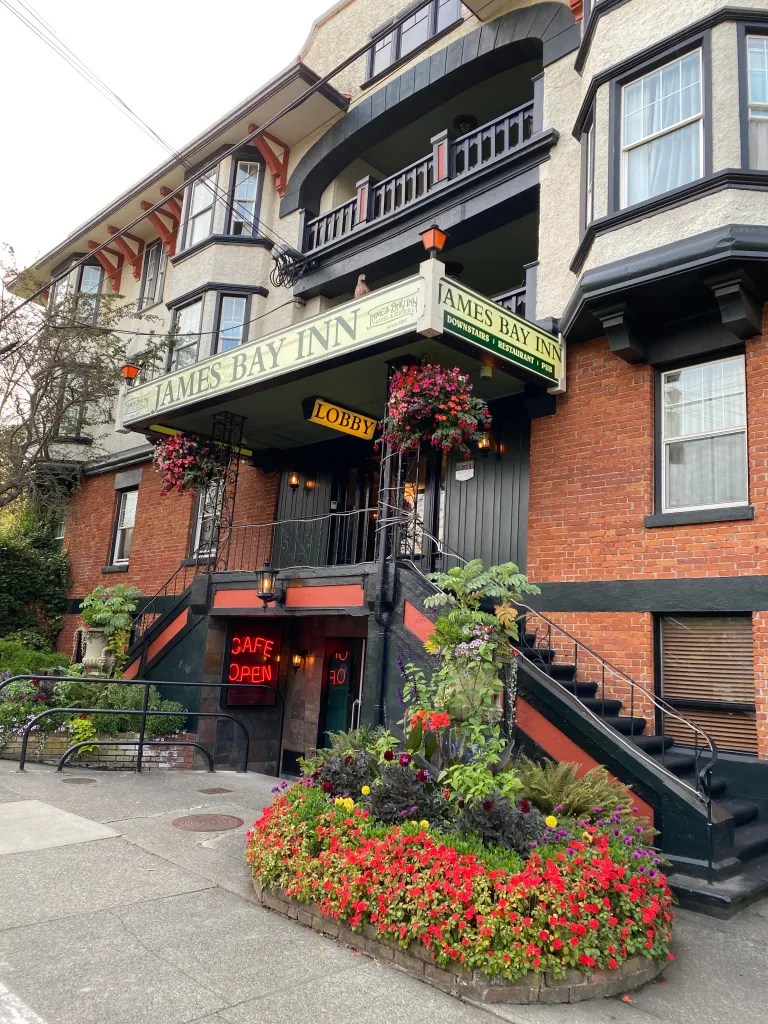
We stayed in the adorable James Bay section of Victoria which is a small peninsula on the coastal side of the city of Victoria. Our sweet hotel, James Bay Inn (Hotels.com), is a 100+ year old sweet inn with a lovely pub and restaurant underneath. Plus it’s a nice walk from there to Floyd’s Diner (fantastic and friendly staff) with standard to funky delicious breakfasts. Also walkable to the parliament building (Victoria is the capitol of British Columbia), seaport, shoreline and seaplane port.
So many locals riding bikes and walking their way through this lovely small city. Fisherman’s Wharf is a sweet area with colorful houseboats that are actually shops and restaurants and also residences right on the Victoria harbor.
Hike at Jocelyn Hill
The Highlands area of Vancouver Island is hilly and tree covered with little towns sprinkled in between. The hike for the day was in the Highlands at Jocelyn Hill. A 5.5 mile hike through a gorgeous canopy of trees with views of the Finlayson Arm (the body of water) along the way.
Bear spray* is a must on this hike as some bears have been spotted here. Use the All Trails app on “navigate” to follow the trail easier as some signs are missing. There is cell service throughout the hike. Hiking poles may be needed for a few all dirt steep downhills.
*Bear spray cannot be taken on planes as it’s kind of like mace. I purchased mine at Canadian Tire which is a sporting goods store and seems to be everywhere in the Vancouver/Victoria area.
Things to do in Whistler
Driving from Vancouver to Whistler
The 2 hour drive from Vancouver to Whistler is absolutely beautiful on the Sea to Sky Highway. It’s right along peaceful waterways (Howe Sound and Squamish River) for the entire ride – up and down mountains and beautiful cliffs flanked by tall pine trees. I drove it in the fall; although, I imagine it’s quite treacherous when there’s any precipitation on the roads with all the twists and turns; and therefore, snow tires are required from October 1 to March 31. There is also a bus that travels the same route.
Whistler
Whistler is ginormous – much larger than I realized. There are 2 villages connected by a path and a 10 minute walk (or shuttle). There is an upper village which is kind of small, as far as amenities go, and the Whistler (central) Village, which is huge and has a lot of everything. There’s upscale shopping, souvenir shops, condos, restaurants, pubs, etc. We ate at the delicious Mongolie Grill for a super healthy and delicious dinner!
The juvenile bear who was roaming the village of Whistler at 8pm!
Drinks were on the patio at Gibbons at the foot of the ski slopes where we saw a juvenile black bear saunter by at around 8pm looking for food. Crazy! Waitstaff were banging on tables, chairs and signs trying to get the bear out of there. The bear actually even climbed 1/2 way up the outdoor stairs to a patio restaurant before he changed his mind!
I’d recommend staying in central Whistler Village. It seems that every single accommodation is beautiful and well-kept.
Hiking in Squamish, British Columbia
Stawamus Chief Trail
Squamish is an adorable town between Vancouver and Whistler. It is about 45 minutes south of Whistler, so we stopped, off the Sea to Sky Highway, on the way back to Vancouver for a hike. Breakfast/Lunch was great at Lil Chef Bistro which is tucked right off of the Sea to Sky Highway.
Hiking was right in Squamish – a meca for climbers! The famous hike is Stawamus “Chief Trail.” This hike consists of about 2 miles of steep, uphill hiking over stone steps, boulders and even man made stairs all in a very large pine treed forest. Precariously located boulders abound – you know, the ones that are on the edge and just thinking about tumbling down while you’re underneath them (but they’ve probably been like that for 100 years)! 🙂
The Chief Trail is definitely a popular one, so worries about bears were lessened, but I was prepared nonetheless. It was a challenging but beautiful trek in the vast, dense Stawamus Chief Provincial Park forest with 2 sets of stairs and 2 sets of chains to assist with hoisting over the boulders near the top. Once at the top of the first peak there’s a peaceful view of Howe Sound and surrounding mountains.
Bear Preparation for Day Hikers
After my large momma bear/bear cub encounter in Montana, I’m NOW prepared for a bear encounter. I carry:
Bear bell (A bell that hangs off my backpack – used so the bear is not startled and/or hears the sound and moves out. It has a magnet that stops it from ringing when not needed.)
Bear spray (Note that you cannot take bear spray on a plane. It’s basically mace that shoots really far, so purchase it at your destination and give it away to another hiker if you don’t use it.)
Smell proof bags (I carry my snacks in here and apple cores, pits from fruit, etc. after eating.)
Satellite communicator/GPS system (When I encountered the Montana bear there was no cell service at all in that national park. No one knew where we were, and there was no one on the trail at all. I worried that if we had encountered the bear on the way out of the out-and-back trail (fortunately, we were still going “in” when we saw the bears) then we would have difficulty finding another route back to the car. This satellite GPS would have solved that issue.)
How I love Switzerland! Everything is beautiful, picturesque and stunning whether in the cities (Zürich or Montreux) or in the Alps (Kandersteg). There’s a feeling of welcoming here as well. I am consistently impressed with how pristine things are in the villages and cities. Here’s how to visit these beautiful areas and still be budget-conscious.
Hiking in KanderstegVillage of KanderstegKandersteg
Things to do in Kandersteg
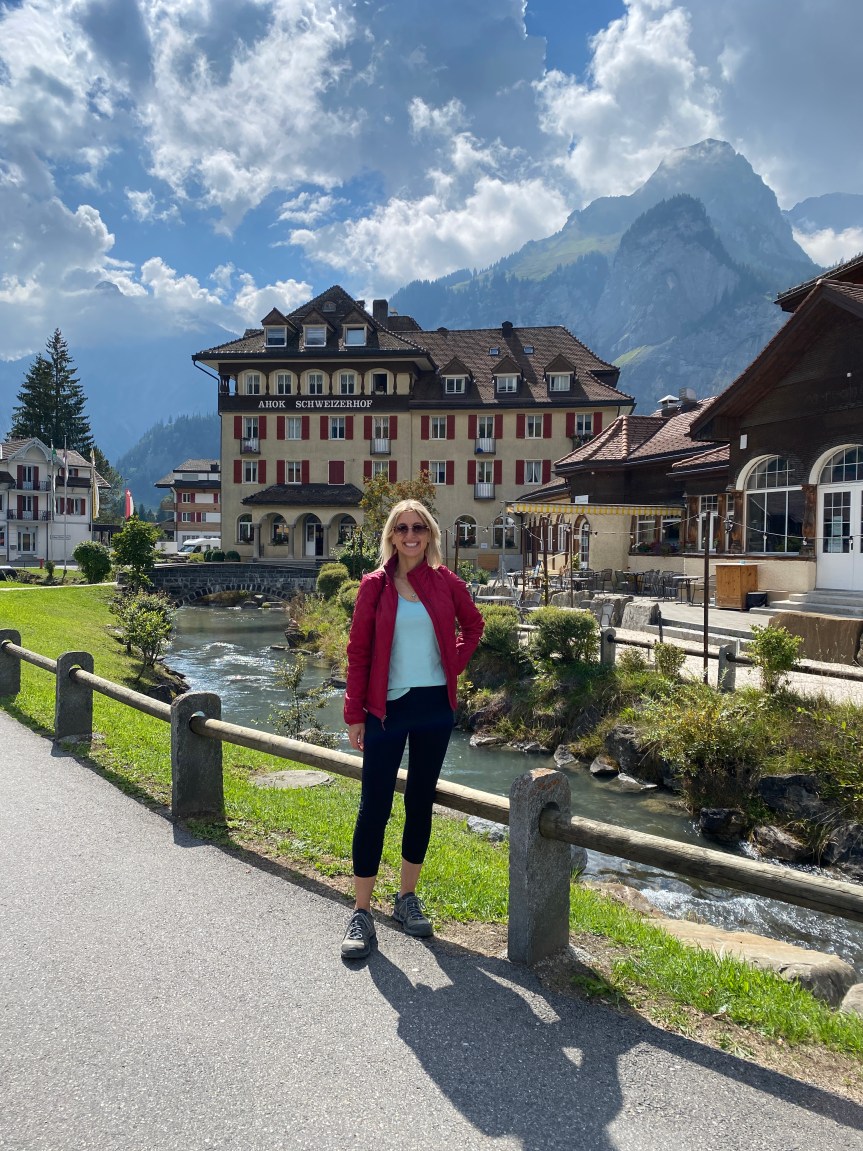
The sweet Alpine village of Kandersteg doesn’t seem to have changed in hundreds of years. There’s only one main quaint road (“innere dorfstrasse” meaning “inner village street”) with flowers blooming on each dark wooded chalet. All is quiet and calm in the village – it feels as though all the townsfolk must be out picking flowers, tending to the sheep or wading in the babbling brooks. It is a location set for outdoor adventures in the summer or shoulder seasons with hiking trails, biking and climbing throughout the spectacular mountains and lakes.
KanderstegLake Oeschinen
Everything, including hotels, are walkable in Kandersteg. Drop off the luggage at your hotel and be on your merry way hiking up to the gondola. Just pick up a hiking map at every hotel’s front desk. The paved sidewalk with a gondola sign is right in the middle of the town and hard to miss. Either take this Oeschinensee gondola lift (~$20 each way) up to the top or hike your way up. It’s mostly paved and very steep. At the upper gondola mountain station there is Restaurant Bergstubli and several little booth options for ice cream, etc. Hike your way to the shimmering and teal Lake Oeschinen (mostly a wide paved path) about 20 minutes away. This gorgeous lake is fed by the glacial Hotels.comstreams. There are options to rent a kayak here. To continue hiking – choose a hike from your map and continue on.
Day 1 continued: I stayed in the quaint Hotel Alpina from Hotels.com which was Swiss through and through with a warm welcoming and warm atmosphere to the old-fashioned keys of the small but clean and functional room. A traditional Swiss breakfast was included.
In Kandersteg the lunch at Hotel Alpenblick was a wonderful traditional Swiss dish – rösti. To me it seemed like very delicious potato hash browns (which I always struggle to make well). I also enjoyed their local beer – Feldschlösschen.
Dinner in Kandersteg was on patio of Chalet Hotel Adler- delicious pizza and great service! There was a good variety in their menu from pizza to steak to fish to pasta.
Montreux is a clean, safe and small city that sits on the eastern shore of glistening Lake Geneva. Although it is in Switzerland, I found most everything from the language to the food to be French. As it happens, Lake Geneva is 1/2 Swiss and 1/2 French with the country borders being only a 25 minute drive away.
Explore the French Swiss village of Montreux. Take a walk on the beautiful flower-lined promenade along the sparkling waterfront. Note that the weather changes constantly so be prepared for light rain to cool overcast to sun! All in 30 minutes! (My trip was in September.) Visit Queen: The Studio Experience (free) located in the casino. My trip here was for the annual Freddie Mercury Celebration Days, a weekend long celebration of Freddie and Queen, which included outdoor concerts, parties, dances, etc. with fans from all over the world. Don’t forget to visit the Freddie Mercury statue on the Riverfront. (Freddie loved the serenity of Montreux and stayed there often. Queen also owned a small recording studio there which is now free to visit inside the casino.)
Eating in Montreux:
Breakfast in Montreux was perfect at Zurcher with French pastries, quiche and fancy sandwiches on crusty French bread and, of course, coffee (café Americano) with an option to sit outdoors. Lunch at Lucky Chinese with very big portions and fresh vegetables with an option sit outside on the patio with overhead coverings.
River cruise from MontreuxLausanne
Day 3: The CGN Riviera cruise is a beautiful, leisurely trip on the peaceful Lake Geneva between the forested mountains that surround this gentle lake. The cruise leaves right from the Montreux lakeside promenade. One side of Lake Geneva is Switzerland and the other is France. There are many options – the cruise that I took had the option to disembark at either Vevey or Lausanne. Vevey is a smaller, more quaint village while Lausanne had more action and is more of a city. Check out the lakeside walk, Olympic Museum or Lausanne Cathedral. Hopping on the train to return to Montreux – I was pleasantly surprised by the beautiful vineyards on terraced farms right out of the train window during this trip!
Swiss fondue!Zurich at duskDrinking water in ZurichZurich!
Things to do in Zürich, Switzerland:
Discover downtown Zurich!
(Travel Tip: Take the train to the Zürich Airport [Flughafen] and take the airport shuttle to your hotel to drop off your bags. I always stay at the Holiday Inn Express in Ruemlang on Hotels.com. It’s a short walk to the Ruemlang train station – simply take the train to Zürich HB.) I
It’s a lovely and safe walk in the historic district, Altstadt, as you head toward the Limmat riverfront. If fondue at a restaurant on the cobblestone streets of Zürich is on your bucket list (as was mine) then walk 8 minutes to Swiss Chuchi restaurant for a delightful, delicious and reasonably priced fondue. This area boasts many high end boutiques (bring your large Francs), quaint shops, hotels and loads of restaurants with outdoor and indoor seating. Don’t forget to go down the cobblestone alleyways for more shops and restaurants.
The train at the Zurich AirportThe board on the train indicates the next stopsPlatform B41
How to easily travel throughout Switzerland on the train
It’s so easy to get around the entire country of Switzerland on their super efficient train system. Here’s step by step instructions:
Upload the SBB app
Add info as a guest or make an account (to stow credit card number)
In Timetable, type in origination and destination
Tap on the option to purchase ticket (no need to buy it at the kiosk)
A conductor will come through, while on the train, to check the ticket while the train travels
To change trains en route, consult the app for the platform to disembark and the one where the next train will depart. Note the change time – it’s often 5-10 minutes. It’s usually via a tunnel underground.
Note that the conductors usually stand outside the train doors, so signal them if you’re running to catch that train at departure time, if needed.
I don’t get the Swiss pass as I’m usually on a quick trip – 4 days or so. (Note that the train station at the Zürich Airport – “Zürich Flughafen” – is right across the street from the terminal and is easily walkable with great signage and also has an indoor mall with food options before you head down to the tracks.)
If you were raised in New Jersey (as I was) then the Jersey Shore is gold. It’s the ultimate vacation spot. The place to go yearly, or more, with familiar and local spots (that are also locally owned) – bakeries, ice cream shops, surf shops, delis, beach stores, boardwalk rides and arcades. It’s all there for the taking and welcomes you back. I love this place so much, but I’m not sure if I love it because it’s got everything with such beach charm (walkable mom and pops everywhere) or because I grew up going there every summer. Probably both.
“Down the Shore” is how you would indicate that you were going to the beach/boardwalk area if you live in the northeast where the NJ Shore is your closest beach.
There are about 130 miles of shoreline in New Jersey. The particular area of the shore that I love is the Barnegat Peninsula; although, almost no one calls it that. See below.
The Barrier Island (or Barnegat Peninsula) *
*Note that most people just refer to it by the name of the community**, and each community is small (maybe 2-8 streets).
**Includes: Chadwick Beach, Ocean Beach, Normandy Beach, Lavallette, Ortley Beach and Seaside Heights
This seaside barrier island is perfect for those who love both the beauty of the ocean and the peacefulness of the bay, since you can easily walk from the ocean to the bay from almost any house on this “island.” When the main north/south road, Route 35, splits (just below Mantoloking) is where my heart lies. Here houses have traditionally been small “bungalows” where families jammed in for summer vacations from North Jersey and the surrounding areas. After “Superstorm Sandy” in 2012, many of the homes were destroyed by flooding and many of the communities allowed larger homes to take their place. Most homeowners tore down their home or raised it, but there are still some bungalows to be found. Homes are jammed together down streets that connect the ocean to the bay and people are out and active – walking, riding bikes, flying kites, or on kayaks, surfboards or boats.
Where to Stay at the Jersey Shore
I love to stay in a home with the bay in the backyard (“on the lagoon”) so even mornings and evenings can be spent in the presence of water. Days are spent on the beach or in the many lagoons on rafts, paddle boards, kayaks or boats. Or crabbing right off the dock! Nights are spent at the Seaside Heights boardwalk, playing mini golf or out for ice cream!
Many of the homes are rented through the community’s local real estate agency. Many do things the old fashioned way with paper contracts, checks and cash even. I do not recommend renting a house in Seaside Heights or Seaside Park even though the rentals are typically less expensive here – the atmosphere there changes throughout the day/night.
Beach badges – beach badges are required to enjoy most NJ beaches. The badges are usually about $35 per week or $12 per day. Purchase the badges (typically cash only) when entering the beach.
My list of favorite beaches, in order, are: Ocean Beach, Chadwick Beach, Ortley Beach, Lavallette, Normandy Beach and Seaside Heights.
Below are some of my favorite spots:
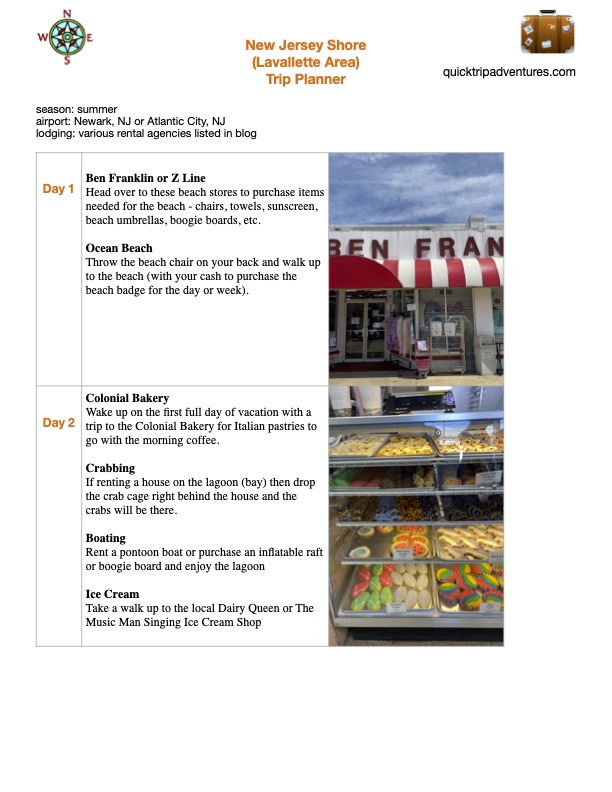
Colonial Bakery – there are 2 Colonial bakeries and my favorite is the smaller one in Ocean Beach (3091 Route 35N). When you walk through the door, in the morning, you will be overwhelmed by the fantastic aroma of freshly baked deliciousness. Wonderful cannolis, cream puffs, eclairs and many Italian treats.
Lasolas Market/Deli – This is the epitome of the little Italian market with a beautiful, mouthwatering array of prepared Italian foods, the best cold and hot sub sandwiches, delicious entrees and much more including Italian bakery delights and even anything you’d need to cook Italian at your house. (One day I bought the chicken parmesan, stuffed artichokes, eggplant parmesan, and broccoli rabe.)
Ocean Hut Surf Shop – This surf shop is my absolute favorite shop at the shore. They have very nice casual clothing and accessories and they even have their own brand of surfboards – cream – with very cool matching apparel. The same owner since 1975!
Seaside Heights Boardwalk – I hope you have not watched Jersey shore. Seaside is so much more than those kids and their drama (sorry, NJS fans). The Seaside Heights/Park Boardwalk is a 2-mile long family friendly* boardwalk that’s action-packed from lively arcades (Lucky Leos and Casino Pier are my favorites) that include classics (skee ball!) and tons of games! There’s a large pier (Casino Pier) with loads of rides for everyone from “kiddie” to “thrill” rides. As you walk down the boards, there are games calling your name – frog bog, darts, water gun competitions, balloon busts and candy wheels. There are also wonderful delicious foods like Kohl’s ice cream, Midway’s Italian sandwiches (sausage, peppers and onions!), 3 Brothers pizza (gigantic slices), and funnel cakes!
*Now to end this paragraph on the Seaside Boardwalk – you’ll want to go during the day to the boardwalk (and not on the beach because it’s packed with people and a little crazy sometimes) and only stay until 9:00pm or so. Fireworks start at 9:00pm on Wednesday night – that’s a good time then leave soon afterward. After that the family atmosphere seems to diminish.
The Crab’s Claw – The best restaurant to go for crabs, clams, oysters, shrimp, flounder, etc. with a lovely and fun atmosphere and just a block from the beach.
B&B – B&B in Lavallette has the best sidewalk sales on the weekends. It’s where I bought my swimsuits each summer plus they have the cutest beachwear and gifts.
Ben Franklin 5&10 Store – If you’ve forgotten anything needed for the beach then you can find it here at reasonable prices. I’ve been going to Ben Franklin for many years for kites to fly on the beach at sunset!
Z Line – Z Line has very reasonable shirts, sweatshirts, souvenirs and even hermit crabs (which we have unfortunately purchased various times throughout the years :] )
**Note that many of the local restaurant establishments only take cash!
What I Love about the New Jersey Shore
Rolling down the windows over the bridge on Bridge Avenue, as you arrive at the shore, to smell the delightful salt air
The cool breeze right when ascending the sand dunes at the beach
Sand that’s perfect for building sand castles
People walking or biking around in bathing suits with beach chairs strapped to their back
Walking to the little ice cream shops and waiting in the long but fast moving lines.
American flags waving in the wind
Walking to local pizzerias, delis and sub shops
The local bakeries!
Families carrying blow up boats to the bay beach
Flying kites at dusk in the summer breeze
Houses crowded together – not a spot of land wasted
How to Get to the NJ Shore from the Newark Airport
From Newark (EWR) Airport terminals – take the AirTrain to the last stop. Follow signs to NJ Transit and NJ Coastal Line (NJCL). Get NJ Transit app and pay for the ticket to Bayhead (most likely you’ll have to change trains in Long Branch). At the Bay Head station take an Uber or a taxi to your rental property.
Things to do near Bozeman/Big Sky, Montana (summer)
Lush green mountains with snow capped peaks leading down to fast running rivers and emerald colored valleys with long grasses flowing in the wind. Montana! So much beauty in one place filling up all the senses! Wildlife is abound – deer, peacocks, sheep, and even bears (more about that later). The rolling hillsides and babbling brooks are also scattered throughout this very alive landscape.
Everything around this area of Montana seemed to be very well maintained from the state roads to the interstates (surprisingly as their winters are rough) as well as the towns in between. I usually enjoy the backroads; however, even the highways had stunning views. I found the roadways to be mostly flat throughout most of the areas that I traveled.
Accommodations near Bozeman
Although it is probably easier to find a place to stay in downtown Bozeman, I highly recommend staying at a VRBO outside of town to get more of a feel for the Montana lifestyle. I stayed with an extraordinarily amazing couple who maintain their own road, build their own barns, fell their own trees, make and cook their own food, and many etceteras. They have a yurt on their property to stay in during your visit.
Downtown Bozeman and Downtown Livingston
Downtown Bozeman
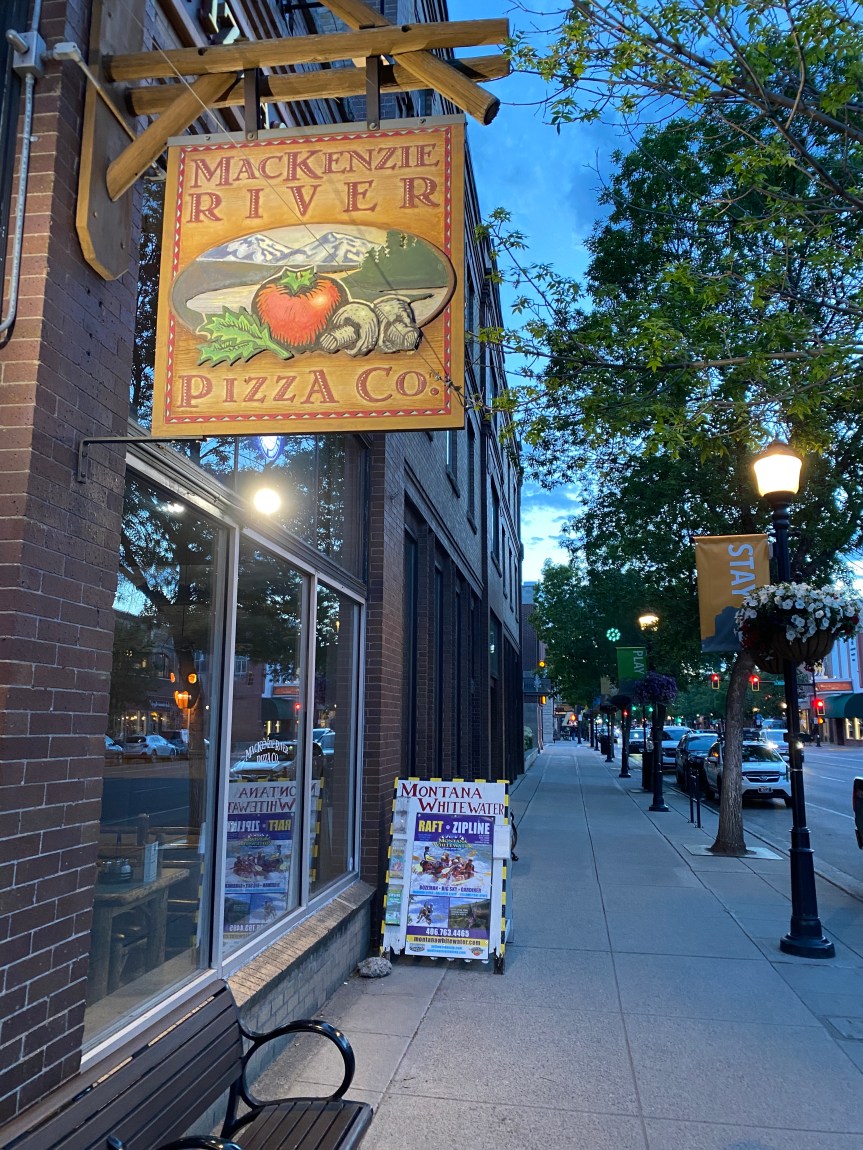
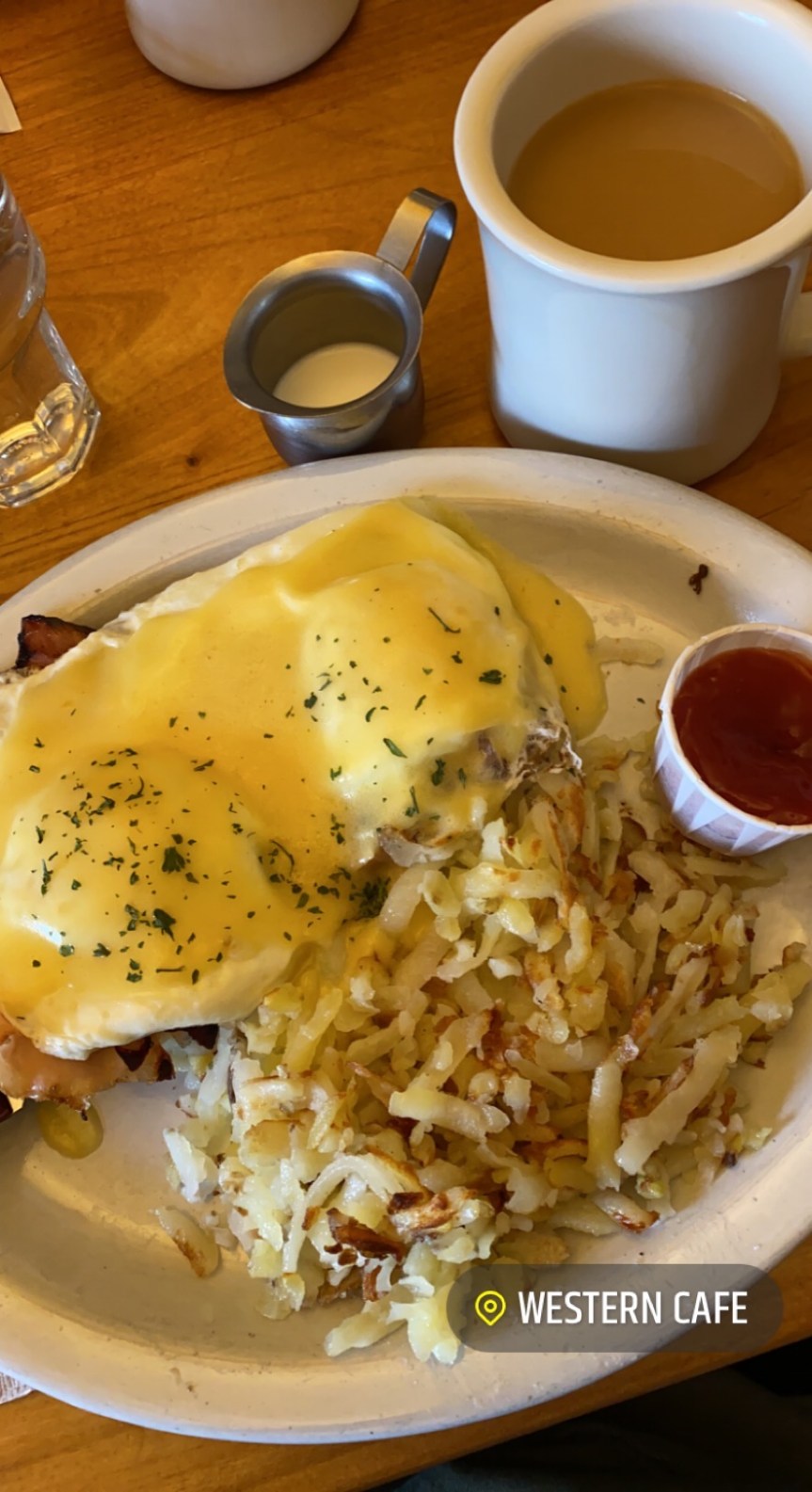
Downtown Bozeman is much larger than I expected it to be with upscale shops, restaurants, pubs and art galleries all within walking distance. I loved the Western Cafe for breakfast – it was a traditional old school diner with mouth watering breakfasts saloon style. MacKenzie River Pizza Company had delicious pizzas and lots of options (including gluten free crust).
Downtown Livingston
Downtown Livingston is a small town with eclectic, locally owned shops and funky restaurants. I loved Pinky’s for breakfast (quick service, good food and friendly staff) and Neptune’s for dinner with a funky vibe, rooftop bar and large, spacious restaurant. The menu is diverse with sushi and American options. Locals recommended Faye’s Cafe for breakfast (limited hours and closed on Friday) and Murray Hotel Bar.
Hiking near Bozeman
So many options for hiking — long, short, easy, difficult. Remember that you are at a bit of an altitude (5,000-7,200 feet high) so you may be breathing a bit heavier at times. If you’d like to go the non-planning (of the hike) route then take a spectacular scenic drive between Bozeman and Big Sky on US191 through the Gallatin National Forest and there are many signs for hiking right off of that road. Just stop, get out and hike from that trailhead. Note that once you enter the National Forest there is no cell phone service.
Hyaline Creek Trail – I chose this trail as it was moderately challenging with a good distance and pretty waterfalls. However, not sure I really recommend it. The signage at the trailhead is confusing. Turns out you should go toward Grotto Falls if you’d like to see waterfalls and not follow the creek trail sign from the trailhead. Going the other way (creek trail sign) we only saw one very small waterfall (albeit, pretty) and at 3.1 miles into the trail (by the reservoir) we startled a very large mother bear and her cub. Fortunately, she did not come after my son and I, but it was a terrifying experience. I learned that if you hike in Montana that you should carry bear spray (you have to purchase it locally – it can’t fly on a plane) and put a bear bell on your backpack as not to startle the bear. Also, you should make yourself look large while talking, facing the bear, and backing away to make the bear realize that you’re human and not threatening. We did none of those things. You are NOT supposed to turn and run, but let me tell you something, when every cell in your body tells you to run, you run. (Maybe role play it before you go out there – idk – just a weird thought.)
Ousel Falls Park Trail – We actually chose this trail as we had to “face our fears” after encountering the mother bear and cub on the Hyaline Creek Trail the day before. Although, this waterfall was just beautiful and the trees were giant and abundant, this trail was very popular with people. And the trail was gravel but practically paved. So, I would recommend it only if you have just a short time and would like to see a pretty waterfall and then go to the next activity which, for us, was whitewater rafting. This trail is less than 30 minutes from Montana Whitewater Rafting.
Lava Lake Trail – this trail was highly recommended by locals. Moderate 6-mile hike.
Whitewater Rafting near Bozeman
Montana Whitewater is closer to Big Sky than to Bozeman; however, if you’re coming from Bozeman the ride is so beautiful that it is well worth the trip. There were 3 rafting options to choose from at the time of our trip – more challenging, less challenging and least challenging. Note that water levels change often so the rafting levels do too. If you’d like to whitewater raft at a place that is all about safety then Montana Whitewater Rafting is the place for you – they provide the helmets, life vest, jacket, full wetsuit and booties. Also, they have many other adventures to add to your experience like zip lining, fly fishing, horseback riding, kayaking, etc.
Tubing near Bozeman
Madison River Tubing – I did not tube as I chose to whitewater raft instead. However, this tubing place came recommended by locals, so I thought I’d throw it in if tubing is more your speed.
Hot Springs near Bozeman
After a long day of hiking, the Bozeman area has 2 hot springs to enjoy to ease your sore muscles. Note that the hot springs are captured in more of a swimming pool (with both spring water and added water) to make it more comfortable to soak in. (I think I was expecting a Romanesque bathhouse which it was not.) We went to the hot springs in Chico. The springs were a soothing 99-100+ degrees. There is also the Bozeman Hot Springs.
Gruene is a splendid, charming, rustic-yet-upscale Historic District (of New Braunfels) in the Texas Hill Country – less than an hour south of Austin. There’s a lot to do in Gruene (pronounced: “green”) for a long weekend or a couple of days: entertainment, shopping, antiquing, wine tasting and active options for all ages in this pleasant district that is very well-kept and surrounded by large, beautiful trees and rivers.
I was in Gruene in May and the weather was right for all the outdoor activities plus hanging out in town, and it wasn’t too crowded. Fall and winter are also usually pleasant in Gruene – typically highs are in the 60s (winter).
Downtown Gruene:
Downtown Gruene is walkable from one establishment to another with many upscale boutiques, outdoorsy-type shops, wine tastings along with cute, tasty restaurants and bars sprinkled throughout this historic district. Bonus: to-go drinks are allowed in most of the shops. Gruene was established in the 1800s by German immigrants and some of those remnants remain and have been re-vitalized in the downtown.
Live Music in Gruene:
Live Americana and blues music happens every night at the historic and oldest music hall in Texas (1878!) – Gruene Hall – right in downtown Gruene. It’s super cool and Texas-y with wooden floors, wooden long picnic tables near the stage and an overflow area outside, under the trees, with tables as well. Dancing is encouraged in and out! It’s really a fun place to experience and to discover new, old and popular musicians. Note that not much has changed at the hall since it opened in the 1800s including any type of climate control (read: no air conditioning), so keep that in mind and dress accordingly and bring your cash as that’s all that Gruene Hall accepts.
Outdoor Activities in Gruene:
Tubing in Gruene:
Tubing is a wonderful way to spend the afternoon gliding down the cool, mostly tame Guadalupe River where the Bald Cypress trees with their expansive root system majestically frame the clear river. Many options are available depending on the river you choose (Comal vs. Guadalupe) and the length of the trip. I chose the Rockin’ R River Rides tubing company which has well-maintained tubes (open and closed bottom), professional employees, timely and clean vans for the transport back. The tubing company sells beer, canned drinks, pre-made sandwiches and snacks to purchase before your trip at reasonable prices. Bring your own cooler (and rent a tube for the cooler) – and you can make it through the sets of rapids (fun and not dangerous) with your drinks intact if you keep the cooler tube close to you.
Cave Near Gruene:
Natural Bridge Caverns are a spectacular U.S. Natural National landmark and only a short 25 minute drive outside Gruene. There is an extensive 2-mile cave with many open rooms, underground river, various beautiful stalagmites, stalactites, curtains, etc. I learned quite a bit during the Discovery Tour which was about an hour and 1/2 long. There are other types of tours available including the adventure tour where you’ll need gear for more of a “caving” experience. The entire area is beautiful! On the property there’s also a ropes courses with zip lines. Also the Natural Bridge Wildlife Ranch, a wildlife safari drive-through tour, is right next door.
Fly Fishing on the Guadalupe is also an option for trout, bass, carp, etc. Check out Gruene Outfitters for equipment, guides, and locations.
The Grist Mill Restaurant is another must-do. It sits high above the Guadalupe River and has outdoor (tiered patio) and indoor seating (in an 1878 cotton gin) with delicious meals at reasonable prices and a Texas-y flair. Expect to wait some time if it’s high season – perhaps go at odd hours (between lunch and dinner rush) to reduce your wait time.
The Gruene River Grill is another good option for an American menu and was highly recommended to me by a 29-year local resident (so “loved by locals”).
Cantina del Rio is a fun, funky and colorful Mexican restaurant with a tree-covered outdoor space as well as an indoor dining room. Great food and good prices and burgers for those who aren’t Mexican foodies.
The Gruene Mansion Inn has been “gently resisting change” since its opening in 1872. Each cottage has its own porch and patio with unique Victorian style rooms dating back to the Gilded Age. Some cottages have a view of the river far below. I loved the Pantry which has a simple and tasty breakfast menu and a nice, peaceful outdoor space to eat it under the mansion’s back covered patio area.
When in Zermatt you actually feel immersed in all that is Switzerland. Zermatt is a well-kept Alpine village surrounded by majestic mountains with warm, traditional Swiss chalets abound. Narrow, windy roads are easily walkable throughout this relaxed and comfortable community. My experience was in winter (February), and I found Zermatt to be appealing for both outdoor adventurists and for those who would like more of a relaxing/sightseeing trip.
For places to stay check out VRBO, Hotels.com, Booking.com, or Travelocity.com. Budget travelers – check out Hotel Adonis. Perfect location and so much more (additional info below).
I have observed that, unlike in the United States, people at Zermatt will utilize the ski lifts (gondolas and trains) to go up to the summits (Gornergrat or Matterhorn Glacier Paradise) to take in the views, eat in the restaurants or shop and then take the gondola back down the mountain. There are not only skiers and hikers on the gondolas.
How to Get to Zermatt
The Swiss make it super easy to travel within their beautiful, picturesque country. Fly into Zürich and just hop on the train at the airport – easily follow the signs both in Swiss-German and in English. Purchase a ticket at the kiosk (near the train) or use an app on your mobile device for the ~3.5 hour trip to get to Zermatt. The SBB mobile app is my app of choice in Switzerland as it gives the platform (track) number of the train. There will be at least one change of trains going to Zermatt and, on many occasions, there are only 5-6 minutes to change trains, so knowing the platform number in advance is helpful. Purchase a ticket as either a full day pass (no times are on it) or for the exact time of the train you’d like to get on which is a little less expensive. No need to validate the ticket at the station – the conductor will check the ticket on the train. Also it is best to purchase tickets ahead of time as the closer it gets to the date of travel the more expensive the ticket seems to get.
Tip: The luggage cart (trolley) is free at the Zürich airport and can be pushed right down to the train. I have even seen people take the cart onto the train; although, I’m not sure if this is actually allowed.
Snowshoeing, Hiking, Downhill Skiing or Sightseeing in the Mountains in Zermatt
The Gornergrat train is a beautiful cogwheel mountain train that lifts riders up on a 4,900 foot journey (33 minutes) from Zermatt up to the mountain ridge of Gornergrat to begin skiing, hiking, snowshoeing, gazing from the observation points, dining at the restaurant, shopping or checking into the hotel. Beautiful views, at 10,285′, of the Matterhorn and Gorner Glacier await the passengers at the upper station. To get there take the train from Gornergrat train station (everywhere is walkable in Zermatt) which is right across from Zermatt train station to purchase a ticket on the train up the mountain.
Tip: When on the Gornergrat train – sit on right side, and you’ll be treated to magnificent views of the Matterhorn! You will go through a few other brief stops at other stations – wait to disembark at Gornergrat (last) station.
To downhill ski, start your trek right there when you exit the Gornergrat train.
To hike or snowshoe, stay on the left side of the ski slope/”piste” on the same slope as the skiers. If you are snowshoeing, at this point, you can either stay on the edge of the slopes, or you can go through the deeper snow off to the sides of the slopes. There will soon be deeper snow to traipse through – stay patient. After you get to the Rotenboden tiny station, go under the bridge and stay hard left to follow the pink arrow to Riffelberg. This is a hikers’ trail. (Sign is in photo collage above.)
After the bridge, while you’re on the “hiker only” trail, just go off the trail and trudge through the glorious sparkly snow and up and down the hills with a view of the Matterhorn and gorgeous mountains all around you! (Only go off trail if you are wearing snowshoes – the snow is way too deep for hiking boots only.)
To continue snowshoeing follow the pink poles which will take you through the deep snow but within view of the hiking trail. The Riffelberg station comes too soon. Then you must take the train (gorgeous views again) back to Zermatt.
Downhill Skiing in Zermatt
Zermatt is a downhill skiers’ paradise. Miles and miles of groomed ski slopes/”pistes” with options for off-piste skiing. Even the gondolas to get you to the pistes are beautiful and include many interconnections to get skiers from one side of the mountain to the other with the option to even ski to Italy. The map of the ski pistes is available pretty much everywhere in the village.
To start your downhill ski day: walk (there are lots of skiers walking the streets in ski boots) or bus to the Matterhorn Glacier Express enclosed lift/gondola. To reach the summit, at 12,740 feet, will take approximately an hour. At the Furi station change lifts to Schwarszee. At the Schwarszee station change lifts to Trockener Steg to the very top of “Matterhorn Glacier Paradise” (also called: Klein Matterhorn). At the top you’ll find ski slopes (“pistes”) as well as lookout areas, restaurants, shops and amazing views of the Alps including those in Italy and France! This is where the large wooden cross is located. Then start skiing down while utilizing the map to get to a variety of pistes as well as aprés ski locations! (Alternatively, the gondola also goes back down for those who do not wish to ski.)
Nordic/Cross Country Skiing near Zermatt
Although there are no Nordic ski trails/tracks right in Zermatt, the Swiss make it so easy to hop on the train (12 minutes) to Täsch and rent Nordic skis right in the Täsch train station. The grooved cross country ski tracks, for “classic” Nordic skiing, are right outside the door of the station with pretty views of the surrounding mountains and the Matterhorn in the distance. The soundtrack to the cross country ski experience is the babbling river near the train tracks. The area is mostly flat, so it’s suitable for beginner Nordic classic skiers. There are also trails alongside the tracks for skate skiers.
To get there from the Zermatt train station take the “Zermatt Shuttle” train to Täsch. It’s the train on the far left track. You can buy a ticket at the kiosk or at the manned booth. Again, it’s just one quick 12 minute station away. The ski rental store is located within the train station with reasonable rates for boots, skis and poles. There are lockers (2 CHF) within the station if you need to store your stuff.
Hiking from Zermatt to Z’mutt
The scenic ~5 mile round-trip hike to the hamlet of Z’Mutt is well worth every step. The path wanders through forests and meadows with Swiss huts sprinkled in while majestic mountains surround you. The Matterhorn grows larger in your view as you hike closer to the hamlet of Z’Mutt. Bonus: When reaching Z’Mutt you are transported back in time into a quiet, tiny village with sturdy huts huddled close together and a central church. The adorable mountain restaurant/cafe at Z’Mutt has rave reviews; however, it’s closed one day – Monday (the day that I went). 🙁 Even so, their patio was a fabulous place to sit and soak in the views.
Begin your hike from Schwarzsee cable car station in Zermatt. Walk directly across the street from the station and take the set of stairs going down to cross the pedestrian bridge over the river. (It took me 10 minutes to find the stairs, but they are right there – in plain sight!) Once you are at the road, turn left then stay to the right side of the median through the bus stop lot. The path will soon turn into a hiking path with a gradual ascent all the way up to Z’Mutt. There is one Y with a pink signage (photo above) – just stay to the right. I took this same trail back. An alternative route is to take the road.
Budget Accommodations in Zermatt
Hotel Adonis is where I stayed on my Zermatt adventure. Although it is a budget hotel, it is in a perfect location to both the main strip and ski lifts (walkable in ski boots to Schwarzsee cable car station), super clean, full of amenities with beautiful Swiss architecture. I can’t say enough good things about it. The lobby area included a reasonably priced and well-stocked bar with tables, chairs, and couches to hang out in. There is a ski room downstairs with a separate entrance to store skis and hang boots on a heater overnight. A delicious buffet breakfast was served every morning (pay for it when booking hotel – it’s less than paying each day). There is also a microwave, tea kettle and tableware available if you’d like to eat in your room.
Transportation in Zermatt:
Zermatt is car free but has many electric taxis to cart you from the train station to the hotel (if you packed heavy items like skis) or if you’d just like a ride. Although most of the town is pretty much accessible by foot. There are also a few electric buses. A note of caution – the electric taxis seem to have the right of way. It is shocking how fast they zip no matter who is on the side of the narrow streets – kids, families with strollers, no exceptions. When you hear that electric buzz – seriously get out of the road.
Eating in Zermatt:
If you are a budget traveler then you can most likely get away with breakfast at the hotel, an appetizer during your après ski time, and dinner. If you love pizza then the North Wall Bar Pizza is exceptional. They’re tossing the dough right there in the seating area which stirs the appetite and the taste is worth the short wait. The raclette (a yummy native Swiss dish consisting of gooey cheese and such (photo on right in block above) was delicious at Weisshorn Restaurant. Hotel Adonis’s sister hotel, Hotel Jägerhof, offers a ton of food for reasonable prices.
Traveling from Zermatt to Zürich
If traveling back to Zürich for the flight out the next day, staying at the Holiday Inn Express near the Zürich airport is your best bet. The hotel rate is extremely reasonable, it’s exceptionally clean with a restaurant and bar, and there’s a frequent and free shuttle from the airport. It’s also just a 10 minute walk to the Rümlang train station for an afternoon trip into downtown Zürich.
An afternoon in Downtown Zürich, Switzerland:
From Rümlang station take the train to Zürich HB station and head in the direction of the water (Limmat River). Cross the river and head south toward Zürich old town where there’s culture and history as well as restaurants and shops right along the river’s edge and up through the alleyways. That area of Zürich has a very safe feel, even on weeknights in the dead of winter, there were a lot of people out dining and enjoying the night.
An afternoon in Bern, Switzerland:
A different option is to stop in the historic and beautiful city of Bern on your way back to Zürich. The train will pass through this city – just get off. There are lockers at the train station to store your luggage for a small fee. I hadn’t planned this stop, so I just got off the train and started walking. The city had a lovely, warm feel to it. I passed the Medieval Clock Tower, cruised over to the Bear Pit, strolled along the river and filled up my water bottle in the fountains lining the street.